






Portugal à Vista – S07E36 – José Saramago na Caricatura Internacional
José Saramago na Caricatura Internacional: Uma Viagem Profunda à Obra e ao Pensamento do nosso Nobel da Literatura no Portugal à Vista
A Génese da Exposição e a Visão do Porto Cartoon
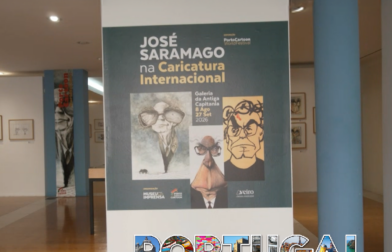
Para compreender a magnitude desta mostra artística, é fundamental regressar às origens do projeto. O intercâmbio cultural que deu vida a esta exposição nasceu em 2013, coincidindo com a inauguração de uma série paralela no World Porto Cartoon voltada para a valorização de figuras cimeiras da cultura nacional e internacional. Desde então, as exposições organizadas em Aveiro têm primado por uma rigorosa coerência temática, cronológica e gráfica. No caso específico da mostra dedicada a José Saramago na Caricatura Internacional, o critério de curadoria afastou-se de divisões estritas por nacionalidades ou cronologias lineares, optando por um dinamismo visual fluido que intercala as mais variadas formas de expressão artística ao longo das salas da galeria.
Mais de quarenta cartonistas oriundos de diferentes geografias mundiais aceitaram o desafio audacioso de transformar a fisionomia inconfundível de José Saramago em matéria plástica. Quando um escritor de tal envergadura é retratado por artistas de sensibilidades tão distintas, o resultado deixa de ser um mero exercício de semelhança física. Os traços marcantes do autor — os óculos icónicos, as sobrancelhas densas e proeminentes, a testa larga e a calvice — funcionam apenas como pontos de partida visuais. Por detrás do exagero caricatural inerente a esta arte, reside invariavelmente uma leitura profunda, crítica e densa da própria obra literária saramaguiana. Caricaturar Saramago revelou-se, para estes criadores, a arte suprema de desenhar ideias, conceitos filosóficos e posturas políticas que marcaram o século XX e continuam a interpelar o século XXI.
O percurso expositivo cuidadosamente capt tabBar pelas câmaras de Portugal à Vista evidencia como a escolha cromática e técnica influencia diretamente a mensagem transmitida por cada obra. Embora a era contemporânea seja marcada por uma transição exponencial para os meios digitais e ferramentas informáticas, a grande maioria dos cartoons presentes nesta mostra exibe a força visceral do traço tradicional. A dualidade entre o preto e branco e a policromia é explorada com mestria pelos artistas. Enquanto o desenho a preto e branco oferece uma imediatez cortante e uma intensidade dramática frequentemente superior à cor, as obras policromadas acrescentam camadas de subtileza narrativa que enriquecem a experiência do visitante.
O Diálogo Permanente Entre o Traço Gráfico e a Palavra Escrita
Um dos aspetos mais fascinantes sublinhados ao longo deste episódio é a simbiose perfeita estabelecida entre a imagem gráfica e a palavra impressa. Ao lado de cada caricatura exposta na galeria, encontram-se os livros que deram origem à inspiração artística. Esta curadoria inteligente permite ao visitante e ao espectador estabelecer um cordão umbilical imediato entre o humor gráfico e a densidade literária. Obras monumentais como O Homem Duplicado, As Intermitências da Morte, Ensaio sobre a Cegueira, Caim e Viagem a Portugal surgem como chaves hermenêuticas indispensáveis para decodificar o porquê de cada traço.
Esta abordagem documental e artística desmistifica a ideia de que a relevância de Saramago se confina estritamente à data da atribuição do Prémio Nobel em 1998. Pelo contrário, a exposição demonstra cabalmente que grande parte da produção literária mais provocatória e madura do autor nasceu precisamente nos anos posteriores a essa distinção histórica. Ao expor os livros juntamente com as caricaturas, a Galeria da Antiga Capitania capacita o público a compreender a imensa riqueza do universo saramaguiano, provando que a literatura do escritor azanheguense continua viva, palpitante e aberta a infinitas camadas de releitura crítica.
A curadoria da exposição soube também integrar o próprio território aveirense na narrativa visual. Na galeria, os visitantes deparam-se com excertos selecionados da obra Viagem a Portugal, onde o autor descreve com a sua habitual agudeza a cidade de Aveiro e o Museu de Santa Joana. Esta inclusão territorial reforça a ligação umbilical entre a escrita saramaguiana e a paisagem portuguesa, criando um ambiente onde a literatura deixa de ser um objeto estático de museu para se converter numa experiência viva, imersiva e profundamente nacional.
Símbolos de Resistência: A Tartaruga e a Persistência Ideológica
No vasto leque de caricaturas exibidas, determinados motivos visuais repetem-se com uma frequência reveladora, carregados de um profundo simbolismo político e existencial. Entre eles, destaca-se com particular relevo a presença recorrente da tartaruga. Este animal de marcha lenta, mas dotado de uma longevidade e de uma resiliência extraordinárias, surge associado a José Saramago não apenas por razões fisionómicas ou anedóticas, mas fundamentalmente como o arquétipo supremo da resistência intelectual.
A tartaruga encarna na perfeição a postura de um homem que escolheu deliberadamente caminhar contra a corrente, questionar dogmas institucionalizados e recusar a apatia social. Saramago foi, ao longo de toda a sua vida cívica e literária, uma voz incómoda para os poderes instalados, escrevendo sempre com absoluta convicção e coragem aquilo em que acreditava. A análise aprofundada realizada no programa Portugal à Vista demonstra como os cartonistas internacionais e nacionais captaram esta essência, transmutando a perseverança da tartaruga em linhas de tinta que celebram a longevidade imorredoura da obra do escritor.
Esta postura de resistência dialoga diretamente com a universalidade do autor. Traduzido em mais de quarenta línguas e lido em mais de sessenta países, Saramago deixou de pertencer exclusivamente a Portugal para se converter num património cívico da humanidade. A exposição em Aveiro prova que, independentemente da latitude geográfica, as ideias fundamentais veiculadas pelos seus livros não envelhecem; pelo contrário, continuam a caminhar lado a lado com os leitores contemporâneos, enfrentando os desafios do mundo moderno com a mesma lucidez implacável.
Perspetivas Cruzadas: Artistas Nacionais versus Artistas Internacionais
A riqueza estética da exposição reside igualmente na contraposição fascinante entre as sensibilidades dos artistas estrangeiros e a visão dos criadores portugueses. Ao observar as caricaturas de autoria internacional, constata-se uma tendência predominante para focar, numa primeira instância, os traços físicos mais óbvios e imediatamente reconhecíveis do escritor. Só numa camada analítica posterior é que o observador consegue mergulhar nas subtilezas da obra literária retratada.
Em nítido contraste, os cartonistas nacionais revelam uma ligação visceral e imediata às raízes culturais e históricas de Portugal. Nas suas obras, a figura de Saramago aparece frequentemente enquadrada por elementos telúricos fundamentais: as planícies douradas e vastas do Alentejo, os campos de trigo, a herança literária de Camões ou o espírito revolucionário e libertador do 25 de Abril. Esta polaridade criativa não constitui uma cisão, mas sim um enriquecimento mútuo, demonstrando como um autor profundamente enraizado na sua matriz pátria pode, simultaneamente, projetar-se com tanta força no panorama universal.
Entre as várias obras patentes, destacam-se composições magistrais de autores portugueses que conseguem sintetizar graficamente a acutilância mental do Nobel. Numa dessas caricaturas de enorme destaque artístico, as sobrancelhas proeminentes do escritor são engenhosamente desenhadas para evocar tanto a sua inabalável inclinação ideológica de esquerda como a grandiosidade do seu cérebro criativo. Noutra obra memorável inspirada em Viagem a Portugal, Saramago surge literalmente a carregar Portugal às costas enquanto caminha resolutamente sobre o globo terrestre, simbolizando de forma poética que as raízes nacionais nunca aprisionam o autor, mas antes lhe fornecem o impulso necessário para viajar por todo o mundo.
Desmontar o Mito: O Humor Extraordinário e a Humanidade de Saramago
Existe frequentemente na perceção pública uma tendência para enquadrar José Saramago através de uma imagem austera, marcada por um olhar severo, uma postura de intransigência intelectual e uma aparente escassez de concessões à leveza do quotidiano. Contudo, a visita guiada proporcionada por este episódio de Portugal à Vista destrói por completo esse preconceito infundado, revelando um Saramago profundamente humano, irónico, lúdico e dotado de um sentido de humor verdadeiramente extraordinário.
A caricatura editorial, pela sua própria génese, atua como uma ferramenta demolidora de mitos solenes. Ao desconstruir a rigidez da figura pública através do riso, do absurdo inteligente e da ironia refinada, os artistas expostos em Aveiro recordam ao público algo que o próprio escritor conhecia intimamente: é perfeitamente possível — e profundamente necessário — pensar, questionar e filosofar através do riso. Esta faceta menos óbvia, mas intensamente luminosa do autor de O Evangelho segundo Jesus Cristo, fica patente em cada canto da galeria aveirense, proporcionando aos visitantes uma experiência emocional e intelectual profundamente enriquecedora.
A cobertura televisiva realizada pela equipa de produção assegura que toda esta polifonia de sentidos chegue aos lares dos espectadores com o máximo rigor estético e narrativo. O programa demonstra que aproximar o público de um Prémio Nobel não exige uma linguagem académica impenetrável, mas sim a capacidade de traduzir a complexidade de uma vida em imagens vibrantes, cores expressivas e testemunhos autênticos.
Uma Homenagem Perene à Liberdade de Pensamento
Em suma, a exposição José Saramago na Caricatura Internacional, brilhantemente documentada neste episódio de Portugal à Vista, constitui muito mais do que uma mera mostra de artes visuais. Trata-se de um manifesto vivo em defesa da liberdade de pensamento, do questionamento permanente e da importância crucial da literatura na formação das consciências cívicas. Ao cruzar o traço irreverente do cartoon com a monumentalidade da prosa saramaguiana, a Galeria da Antiga Capitania em Aveiro reafirma-se como um farol cultural de relevo incontornável.
Convidamos todos os entusiastas da cultura portuguesa, da literatura e das artes gráficas a aprofundarem o seu conhecimento sobre este tema fascinante. Para assistir a este episódio na íntegra, com todos os pormenores visuais, entrevistas exclusivas e reportagens de inegável valor patrimonial, aceda imediatamente à nossa plataforma de streaming de excelência através do link
Watch the Full Episode on CamoesTV+
Se prefere desfrutar de conversas enriquecedoras em formato de áudio enquanto realiza as suas tarefas diárias, ouça o nosso podcast dedicado a este tema imperdível no Spotify em
José Saramago na Caricatura Internacional: A Deep Dive into the Literary Legacy and Artistic Vision of Portugal’s Nobel Laureate on Portugal à Vista
The Genesis of the Exhibition and the Artistic Vision of Porto Cartoon
To fully grasp the magnitude and cultural weight of this artistic showcase, it is essential to trace back the origins of the project. The cultural exchange that breathed life into this exhibition began in 2013, coinciding precisely with the inauguration of a parallel series within the World Porto Cartoon dedicated to honoring towering figures of both national and international culture. Since that milestone year, exhibitions organized in Aveiro have consistently maintained rigorous thematic, chronological, and graphic coherence. In the specific case of the exhibition dedicated to José Saramago na Caricatura Internacional, the curatorial criteria deliberately moved away from rigid national divisions or strict linear chronologies, opting instead for a fluid visual dynamism that intersperses diverse forms of graphic expression throughout the gallery’s exhibition rooms.
Over forty professional cartoonists hailing from varied global geographies accepted the audacious challenge of transforming José Saramago’s unmistakable physiognomy into plastic art. When a writer of such towering stature is portrayed by artists of wildly distinct sensibilities, the resulting creation transcends a simple exercise in physical likeness. The author’s prominent features—his iconic glasses, dense and expressive eyebrows, high forehead, and distinctive baldness—serve merely as initial visual springboards. Behind the playful and often striking caricatural exaggeration inherent to this genre, there invariably lies a profound, critical, and rigorous reading of Saramago’s actual literary texts. Carricaturing Saramago proved to be, for these talented creators, the supreme art of drawing complex ideas, philosophical stances, and political ideologies that defined the twentieth century and continue to challenge the twenty-first.
The exhibition journey meticulously captured by the production cameras of Portugal à Vista highlights how specific color choices and technical mediums directly influence the communicative power of each artwork. Although contemporary society is marked by an exponential digital transition toward software and screen-based media, the vast majority of cartoons featured in this collection proudly display the raw, visceral strength of traditional hand-drawn techniques. The interplay between stark black-and-white contrast and rich polychromy is expertly managed by the artists. While black-and-white illustrations offer immediate visual impact and a dramatic intensity often surpassing color, polychromatic works introduce subtle narrative layers that greatly enrich the visitor’s overall appreciation.
The Permanent Dialogue Between Graphic Strokes and Written Words
One of the most fascinating aspects emphasized throughout this episode is the seamless symbiosis established between graphic imagery and printed literature. Placed side-by-side with each caricature displayed across the gallery walls are the actual books that inspired the artists’ imagination. This intelligent curatorial choice allows visitors and television viewers alike to establish an immediate umbilical cord connecting satirical illustration with profound literary density. Monumental masterpieces such as The Double, Death with Interruptions, Blindness, Cain, and Journey to Portugal emerge as indispensable hermeneutic keys required to decode the exact intent behind every artistic stroke.
This documentary and artistic approach effectively dispels the misconception that Saramago’s cultural relevance is strictly confined to the historic moment he received the Nobel Prize in 1998. On the contrary, the exhibition proves comprehensively that a vast portion of the author’s most provocative and mature literary output was penned precisely in the years following that global distinction. By exhibiting physical books alongside artistic caricatures, the Old Captaincy Gallery empowers audiences to understand the immense richness of the saramaguian universe, proving that the Nobel laureate’s prose remains vibrantly alive, pulsing, and eternally open to endless layers of critical reinterpretation.
Furthermore, the exhibition’s curatorship brilliantly integrated the local Aveiro territory directly into the overarching visual narrative. Inside the gallery, visitors encounter carefully selected excerpts from Journey to Portugal, where the author describes both Aveiro and the Museum of Saint Joan with his customary linguistic sharpness. This regional inclusion reinforces the organic bond linking saramaguian literature to the broader Portuguese landscape, transforming the exhibition space from a static museum into an immersive, living, and deeply national cultural experience.
Symbols of Resistance: The Turtle and Ideological Persistence
Across the vast array of displayed caricatures, specific visual motifs repeat themselves with revealing frequency, laden with deep political and existential symbolism. Among them, the recurring presence of the turtle stands out with particular prominence. This slow-moving creature, endowed with extraordinary longevity and quiet resilience, appears linked to José Saramago not merely for physical or anecdotal reasons, but fundamentally as the supreme archetype of intellectual resistance.
The turtle perfectly embodies the posture of a man who deliberately chose to walk against the societal current, question institutionalized dogmas, and reject complacency. Throughout his civic and literary life, Saramago remained an uncomfortable voice for entrenched power structures, consistently writing with absolute conviction and moral courage about the causes he believed in. The thorough analysis featured in Portugal à Vista demonstrates how international and national cartoonists captured this core essence, transmuting the turtle’s perseverance into ink lines celebrating the enduring longevity of the writer’s work.
This stance of unyielding resistance dialogues directly with the author’s global universality. Translated into over forty languages and read across more than sixty countries, Saramago long ago ceased to belong exclusively to Portugal, transforming instead into a vital civic heritage of all humanity. The Aveiro exhibition proves that regardless of geographic latitude, the foundational ideas conveyed by his books never age; rather, they march side by side with contemporary readers, tackling modern global challenges with the exact same unyielding lucidity.
Crossed Perspectives: National Artists Versus International Creators
The aesthetic richness of the exhibition likewise lies in the fascinating contrast between foreign artistic sensibilities and the distinct vision of domestic Portuguese creators. When observing internationally authored caricatures, one notices a predominant tendency to focus initially on the writer’s most obvious and universally recognizable physical features. Only upon deeper analytical layers does the observer begin to unpack the subtler nuances of the underlying literary text.
In sharp contrast, national cartoonists reveal a visceral, immediate connection to Portugal’s cultural roots and historical memory. In their artworks, Saramago’s figure is frequently framed by fundamental teluric elements: the vast and golden plains of the Alentejo, rolling wheat fields, Camões’s monumental literary heritage, or the revolutionary, liberating spirit of the April 25th Revolution. This creative duality does not represent a division, but rather a powerful mutual enrichment, illustrating how an author deeply anchored in his homeland can simultaneously project himself with immense force onto the universal stage.
Among the standout pieces on display are masterworks by Portuguese authors capable of graphically synthesizing the Nobel laureate’s acute intellect. In one widely celebrated caricature, the writer’s prominent eyebrows are ingeniously drawn to evoke both his steadfast left-wing political alignment and the sheer magnitude of his creative brain. In another memorable artwork inspired by Journey to Portugal, Saramago is depicted literally carrying Portugal on his back while walking resolutely across the globe, poetically symbolizing that national roots never imprison an author, but instead provide the vital momentum required to travel across the entire world.
Dismantling the Myth: Extraordinary Humor and Saramago’s Deep Humanity
Public perception frequently tends to box José Saramago inside an austere image marked by a stern gaze, an uncompromising intellectual posture, and an apparent scarcity of concessions to everyday lightheartedness. However, the guided television tour provided by this episode of Portugal à Vista completely shatters this unfounded prejudice, revealing a Saramago who was deeply human, fiercely ironic, playful, and gifted with a truly extraordinary sense of humor.
Editorial caricature, by its very nature, acts as a powerful demolisher of solemn myths. By dismantling the rigidity of public figures through laughter, intelligent absurdity, and refined irony, the artists featured in Aveiro remind audiences of something the writer knew intimately: it is entirely possible—and deeply necessary—to think, question, and philosophize through laughter. This less obvious yet brightly luminous facet of the author of The Gospel According to Jesus Christ remains palpable in every corner of the Aveiro gallery, offering visitors an emotional and intellectual experience of rare depth.
The rigorous television coverage executed by the production crew ensures that this rich polyphony of meanings reaches viewers’ homes with maximum aesthetic and narrative polish. The program demonstrates that bringing audiences closer to a Nobel laureate requires no impenetrable academic jargon, but rather the unique ability to translate the complex tapestry of a life into vibrant images, expressive colors, and authentic human testimonies.
A Perennial Tribute to the Freedom of Thought
In summary, the exhibition José Saramago na Caricatura Internacional, brilliantly documented within this episode of Portugal à Vista, constitutes far more than a standard visual arts showcase. It serves as a living manifesto defending freedom of thought, permanent questioning, and the crucial importance of literature in shaping civic consciousness. By merging the irreverent strokes of editorial cartooning with the monumental scale of saramaguian prose, the Old Captaincy Gallery in Aveiro reaffirms its status as a cultural beacon of undeniable relevance.
We invite all enthusiasts of Portuguese culture, world literature, and graphic arts to deepen their understanding of this fascinating topic. To watch this episode in its entirety, complete with rich visual details, exclusive interviews, and cultural reporting of immense heritage value, access our premium streaming platform immediately via the link
Watch the Full Episode on CamoesTV+
If you prefer enjoying enriching audio conversations while managing your daily routines, listen to our dedicated podcast episode covering this unmissable topic on Spotify via


